Facts About Cooper Union

Cooper Square
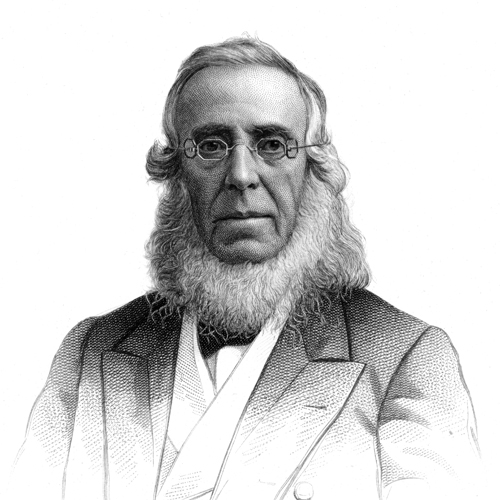
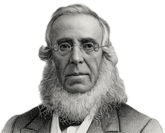
Founded in 1859 by inventor, industrialist and philanthropist Peter Cooper, The Cooper Union for the Advancement of Science and Art offers an unparalleled education in architecture, art, and engineering.
Established to provide education with an exceptional standard of quality “equal to the best,” The Cooper Union was also founded on the fundamental belief that education should be accessible to all members of society without regard to gender, race, religion, or economic status. Today, The Cooper Union is ranked among the most prestigious private institutions in the world with a public mission: prepare bright, creative, and ambitious students to apply their talent and expertise to make impactful contributions worldwide.
For the Academic Year 2025-2026:
Admission
11% overall acceptance rate based on the total number of Common Applications submitted for fall 2025 (4% School of Architecture, 8% School of Art, 16% School of Engineering)
Enrollment
The Cooper Union awards all enrolled undergraduate students a half-tuition scholarship currently valued at $22,275 per school year. After applying for need-based financial aid, students may be provided additional aid to help cover tuition, room and board, and other related expenses. Limited merit scholarships are also available for selected students.
- 834 undergraduate degree-seeking students: 15% in the School of Architecture; 32% in the School of Art; 53% in the School of Engineering
- 51% Female, 46% Male, 3% Nonbinary
- Undergraduate students who are U.S. citizens and residents: 33% are Asian, 7% are Black or African-American, 11% are Hispanic/Latino, 1% are American Indian/Alaskan Native or Native Hawaiian/Pacific Islander, 27% are White, 5% are Two or More Races, and 4% are Unknown, 12% are U.S. Nonresidents
- 21% First Generation
- 72 graduate students: 28% in the Master of Science in Architecture program; 72% in the Master of Engineering program
- First-Year Profile
- 71% of First-year Students Live on Campus
Retention and Graduation Rates
- 89% of students returned for sophomore year (retention rate)
- 82% of The Cooper Union first-year students that entered in fall 2019 graduated within 6 years
Academics
- Accreditation
- 8 to 1 student-to-faculty ratio
The Irwin S. Chanin School of Architecture offers a Bachelor of Architecture degree which is completed over five years and prepares students for an array of opportunities in the profession. The school also offers a post-professional Master of Science in Architecture degree. Through close interaction with internationally recognized faculty, practitioners, and scholars, graduates obtain a lasting ability to produce architecture that is a meaningful synthesis of the social, the aesthetic and the technological.
The School of Art offers a Bachelor of Fine Arts degree completed in four years. The program is committed to an integrated curriculum that encompasses the fundamental disciplines and resources of the visual arts including painting, sculpture, drawing, audiovisual, graphic design, photography, and printmaking. The students in the program benefit from working alongside renowned faculty and utilizing New York City’s extraordinary pool of practicing professionals in fine art and graphic design.
The Albert Nerken School of Engineering offers Bachelor of Engineering degrees in chemical, civil, electrical, and mechanical engineering, a Bachelor of Science degree in computer science, and a Master of Engineering degree. The program prepares students for leadership and entrepreneurial roles in a world that faces complex political, social, and environmental challenges. At the graduate level, the school encourages interdisciplinary studies in additional areas including computer systems, robotics, biomedical, and environmental engineering issues, as well as material science.
The Faculty of Humanities and Social Sciences provides the academic integration connecting our three schools. During their first two years, students are required to take a core curriculum in the humanities and social sciences. Students in the School of Art take an additional three-semester sequence in art history. During the third and fourth years, students have considerable latitude to explore the humanities and social sciences through elective courses. The Faculty of Humanities and Social Sciences also oversees the Center for Writing which works with our students to offer feedback, support, and instruction in all areas of written and spoken communication.
Rankings
The rigor of The Cooper Union’s academic programs has made it one of the top-ranked institutions of higher education in the nation in all categories.
- #1 Best Value Schools, #2 Top Private Schools, #3 Regional Colleges North, #9 Best Undergraduate Engineering Programs, #8 Undergraduate Civil Engineering, #10 Undergraduate Electrical / Electronic / Communications Engineering, #11 Undergraduate Mechanical Engineering, #2 Most Innovative, #3 Best Undergraduate Teaching, #5 Social Mobility, U.S. News and World Report Best Colleges, 2027
- Best Value Colleges, The Princeton Review, 2027
- #2 for Civil Engineering and #7 for Electrical Engineering, top-earnings program rankings, New York Times, 2026
- #8 of 703 Best Colleges for Art in America, #9 of 171 Best Colleges for Architecture in America, #20 of 1,010 Best Small Colleges in America, #27 of 1,615 Most Diverse Colleges in America, and an A overall grade, Niche, 2026
- Awarded a 4.5 out of 5 star rating as one of America's Best Colleges, Money, 2025
- Given an A+ financial grade, Forbes, 2025
Student, Alumni and Faculty Achievement
The Cooper Union’s alumni, faculty and student community have received an extraordinary share of the nation’s most prestigious accolades:
- 40 Fulbright scholars since 2001
- 13 National Science Foundation Graduate Research Fellowships since 2004
- 40 percent of graduates continue to pursue top-ranked graduate programs
- 4 Royal Society of Arts-Architecture Student Design Awards in 2014 (only four awarded in total)
Additional Prestigious Prizes Awarded to Cooper Union Alumni
- 15 Rome Prizes
- 27 Guggenheim Fellowships
- 3 MacArthur Fellowships: Whitfield Lovell A’83,
Elizabeth Diller AR’79, Ricardo M. Scofidio AR’55 - 3 National Medal of Arts Awards: Milton Glaser A'53,
Alex Katz A'49, Jack Whitten A'64 - Nobel Prize in Physics: Russell A. Hulse Ph’70
- 1 Pritzker Architecture Prize: Shigeru Ban A'84
- 9 Chrysler Design Awards
- 3 Thomas Jefferson Awards for Public Architecture
- 8 AIGA Medallions for Design Excellence
- 1 inaugural Jane Jacobs Medal: Barry Benepe A’54
- 1 Queen Elizabeth Prize for Engineering: Dick Schwartz ME’57
Campus
Foundation Building
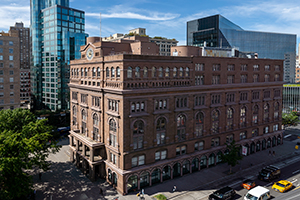
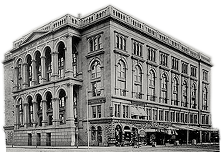
The Cooper Union’s Foundation Building, completed in 1858, was bestowed as a gift to New York City and became a testament to Peter Cooper’s philanthropy and ingenuity. The Foundation Building was once the tallest building in Manhattan and the most innovative addition to the city’s landscape. Designed with a rolled iron I-beam infrastructure, it also included an interior shaft that preceded the common use of elevators. The Foundation Building is also a prominent cultural and intellectual destination for its auditorium, the Great Hall. This space has hosted speeches and events for several United States presidents and esteemed public figures that have had a profound impact throughout American history. Today the Foundation Building is a National Historic Landmark and designated New York City Landmark, and it provides space for classrooms, studios, a library, and the Arthur A. Houghton, Jr. Gallery. The interior was renovated in the 1970s by John Hedjuk, former Dean of Cooper Union's Irwin S. Chanin School of Architecture, and in 2002 an exterior restoration and rededication was completed.
The Great Hall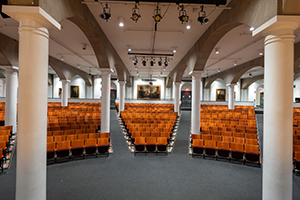
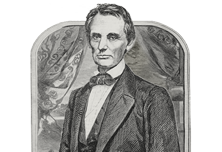
Peter Cooper believed that public engagement was essential to a thriving democracy and designed the Great Hall within the Foundation Building to do just that. The Great Hall was created to bring America’s most influential pioneers of the 19th century to the citizens of New York City. One of the most famous guests was Abraham Lincoln in February 1860 where he delivered his “Right Makes Might” speech. The Great Hall also hosted abolitionist Frederick Douglass, women’s suffrage champions Susan B. Anthony and Victoria Woodhull, Samuel Gompers, and the earliest workers’ rights campaign movements. It was also the birthplace of the American Red Cross and the NAACP.
For more than 160 years, the Great Hall has remained a prominent venue, hosting United States presidents Ulysses S. Grant, William Howard Taft, Grover Cleveland, Theodore Roosevelt, Woodrow Wilson, Bill Clinton, and Barack Obama. Other presenters have included authors Harriet Beecher Stowe and Salmon Rushdie, intellectuals Bertrand Russell and Susan Sontag, scientists Thomas Huxley and Brian Greene, and musicians Benny Carter and Billy Joel to mention a few.
41 Cooper Square
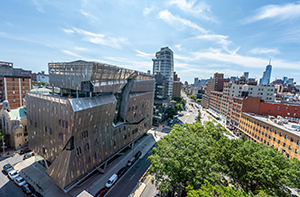
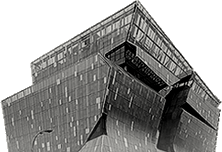
The Cooper Union’s most recent campus addition is 41 Cooper Square, a Leadership in Energy and Environmental Design (LEED) certified academic building. Designed by 2005 Pritzker Prize-winning architect Thom Mayne of Morphosis, the building officially opened in September 2009. The 9-story, 175,000 square foot, full-block building replaced more than 40 percent of the academic space at the college with reconfigurable state-of-the-art classrooms, laboratories, studios, and public spaces.
For more information, please view or download our publications. While you're at it, check out some Cooper student work, or get a preview of Cooper by attending one of our high school programs.